
Suzuki Grand Vitara: Towing Your Vehicle (recreational towing)
Your vehicle may be towed behind another vehicle (such as a motorhome), provided you use the proper towing method specified for your vehicle. The towing method you must use depends on the specifications of your vehicle: whether it is a 2- wheel drive (2WD), 4-wheel drive (4WD) with a transfer switch or 4-wheel drive (4WD) without a transfer switch vehicle. Use the towing instruction table to select the proper towing method for your vehicle, and carefully follow the corresponding instructions. Be sure to use proper towing equipment designed for recreational towing and make sure that towing speed does not exceed 90 km/h (55 mph).
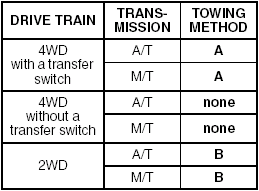
TOWING INSTRUCTION
TABLE
CAUTION: Never tow your 4WD vehicle without a transfer switch using recreational towing methods. If you do, the transmission will be permanently damaged.
4WD Vehicle With a Transfer Switch
 WARNING: When you tow your vehicle,
follow the instructions below to avoid accidents and damage to your vehicle. In
addition, be sure to observe government and local requirements regarding vehicle
lighting and trailer hitches or tow bars.
WARNING: When you tow your vehicle,
follow the instructions below to avoid accidents and damage to your vehicle. In
addition, be sure to observe government and local requirements regarding vehicle
lighting and trailer hitches or tow bars.
WARNING: A safety chain should
always be used when you tow your vehicle.
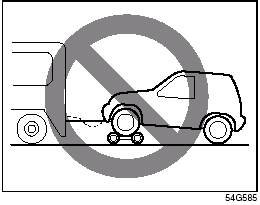
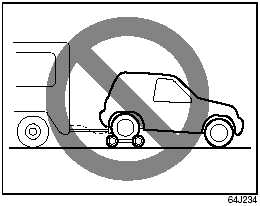
CAUTION: Do not tow your vehicle with either front wheels or rear wheels directly on the ground (and the transmission in neutral). If you do, the transmission will be damaged fatally.
Before towing
Vehicles equipped with a transfer switch may be towed from the front with all four wheels on the ground. Be sure to use proper towing equipment designed for recreational towing and make sure that towing speed does not exceed 90 km/h (55 mph).
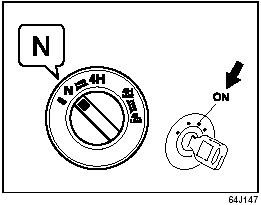
To tow a vehicle equipped with a transfer switch with all four wheels on the ground:
1) Turn the ignition key to the “ON” position. 2) Place the transmission in “N” (Neutral) and depress the brake pedal and the clutch pedal fully (if equipped). 3) Use the transfer switch to shift into neutral.
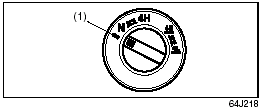
NOTE: First, push in and turn the switch to the mark (1) at the left of the “N” position, and hold the switch in this position for 5 seconds until the “N” indicator blinks, then turn the switch to the “N” position. When you turn the transfer switch to the “N” position, “N” indicator will come on with the buzzer sound.
4) Make sure the “N” light on the instrument cluster comes on. 5) Shift the manual transmission lever into 2nd gear or the automatic transmission lever into “P” (Park). 6) Turn the ignition key to the “ACC” position to unlock the steering wheel. 7) Release the parking brake.
Stop towing the vehicle every 300 km (200 miles). Start the engine. With the manual transmission lever in 2nd gear (or the automatic transmission lever in “D”) and the transfer switch in neutral, rev the engine for about one minute with the clutch engaged (if equipped), to circulate oil in the transfer case.
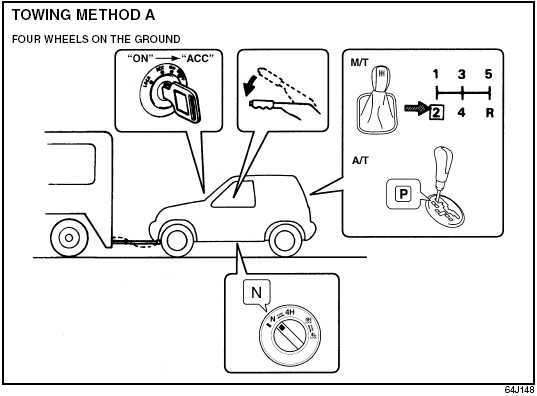
TOWING METHOD
A
4WD Vehicle Without a Transfer Switch
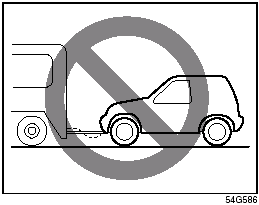
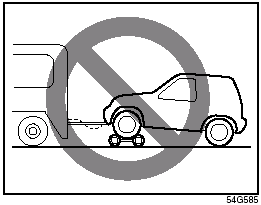
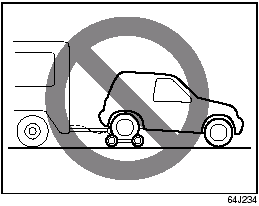
You can not tow your vehicle behind another vehicle using recreational towing methods.
CAUTION: Never tow your vehicle using recreational towing methods. If you do, the transmission will be permanently damaged.
2WD Vehicle
1) Secure the rear wheels on a towing dolly according to the instructions provided by the dolly manufacturer. 2) Turn the ignition key to the “ACC” position to unlock the steering wheel. 3) Make sure the front wheels are facing straight forward and secure the steering wheel with a steering wheel clamping device designed for towing.
CAUTION: The steering column is not strong enough to withstand shocks transmitted from the front wheels during towing. Always unlock the steering wheel before towing.
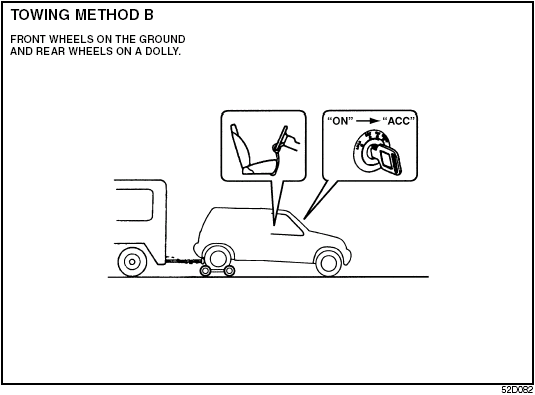
TOWING METHOD
B
 Trailer Towing
See also:
Four-wheel drive operation
MP 143 Single-Speed Part-Time Transfer Case
Operating Information/Precautions
The transfer case is operated by the transfer case switch
(located on the center console).
Transfer Case Switch
The electronically shifted transfer case provides t ...
Foreword
Congratulations on choosing a SUBARU vehicle. This Owner’s Manual has all the information necessary to keep your SUBARU in excellent condition and to properly maintain the emission control system for minimizing emission pollutants. We urge y ...


